Marlow’s Helmsman
Heart of DarknessMarlow’s Helmsman pilots Marlow’s river steamboat during its dangerous journey upriver. Initially presented through Marlow’s judgments of his skill and temperament, he becomes more than a subordinate when his death forces Marlow to recognize the partnership their months of shared work had made. His brief arc exposes both the practical dependence of the expedition on African workers and the limits of Marlow’s own understanding of the people beside him.
Identity and Work
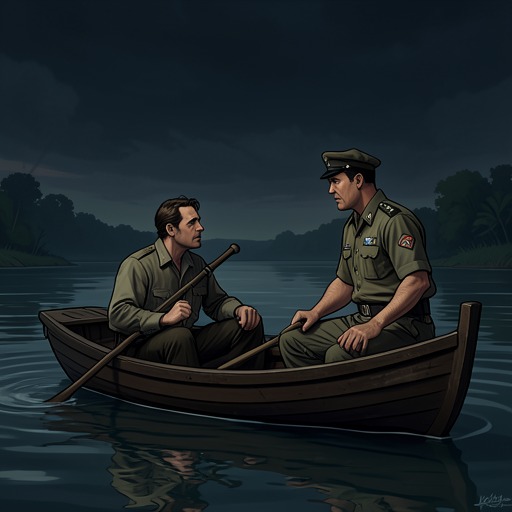
Marlow identifies the Helmsman as a physically athletic man from a coastal community who had been trained by Marlow’s predecessor. He wears brass earrings and a blue cloth wrapper, and Marlow notes that he takes pride in himself. These details establish a particular working presence aboard the boat, even as Marlow’s account filters him through judgments about competence and composure.
At the wheel, the Helmsman can steer with an air of confidence when Marlow is nearby. If Marlow moves out of his sight, however, he becomes frightened and the steamboat quickly slips beyond his control. Marlow calls him unstable and foolish, but the description also shows how much the pilot’s performance depends on being watched and reassured. The man is not simply an interchangeable passenger: the boat’s passage depends on his handling of the wheel, and Marlow has to monitor both the river and the person steering it.
The surrounding stations make that dependence part of a wider material system. The Company’s trade sends manufactured goods inland and draws Ivory outward, while at the river station rivets needed to repair the steamboat remain unavailable despite being plentiful elsewhere. Marlow’s journey relies on workers and improvised repairs amid a disordered supply network organized around extraction. The Helmsman’s labor is essential to that fragile transport, although Marlow initially describes him primarily in terms of how well he performs it.
The Attack on the Steamboat
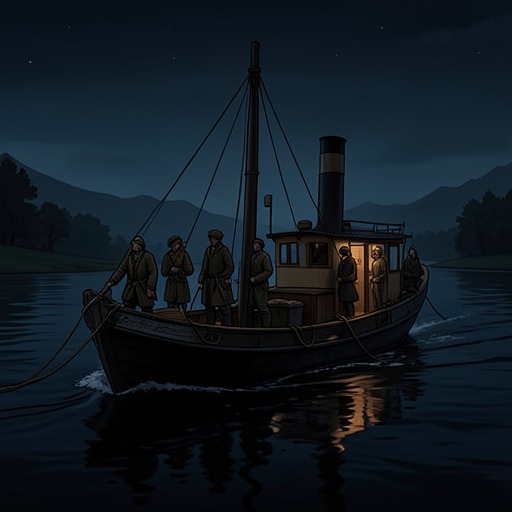
As the steamboat moves slowly through a narrowing stretch of river, the crew first encounters signs of danger without understanding them. The poleman lies flat on the deck, the fireman ducks beside the furnace, and arrows begin striking around the pilot-house. Marlow recognizes that the boat is under attack and tries to close the shutter on the shore side while ordering the Helmsman to keep steering straight.
The Helmsman does not follow that order. Frightened and agitated, he opens the shutter and fires the Martini-Henry rifle toward the shore. Marlow leaves the pilot-house briefly to regain control of the boat, then returns to find the Helmsman still at the opening. In the confusion, the man appears to wrench at something coming from the bank; he is struck by a spear and collapses. The circumstances of that movement are not fully clear in Marlow’s account, which presents it amid smoke, gunfire, and the effort to keep the steamboat moving.
Marlow sounds the steam whistle, and the attack subsides. The Pilgrims’ gunfire has produced smoke and noise, but Marlow doubts that their shots have been aimed effectively. The Helmsman dies without speaking. Marlow asks another agent to take the wheel, then attends to the immediate task of keeping the damaged vessel under control. The sequence makes the cost of the attack inseparable from the expedition’s practical crisis: while the crew is under fire, the person responsible for steering is lost.
Death and Immediate Aftermath
Marlow later removes the Helmsman’s body from the pilot-house and casts it into the river after a simple funeral. His decision is practical as well as abrupt: he believes that leaving the body aboard could lead to conflict with the woodcutters, and he wants to take the wheel himself because the replacement at hand cannot manage it reliably. The Pilgrims and the General Manager are scandalized by the speed of the disposal. Their response contrasts with Marlow’s urgent concern to restore control of the vessel, while the scene also reveals that different groups aboard do not share the same view of what should happen next.
Marlow recognizes that the Helmsman’s death has broken a working bond only after the bond is gone. For months, the man has steered behind him while Marlow watched over his deficiencies and depended on his service. Marlow describes their arrangement as a partnership, though his earlier account had emphasized the Helmsman’s errors. His grief therefore marks a change in his own perception: the man who had seemed to Marlow a poor pilot had also been a constant companion in the work of the journey.
Marlow’s Remembrance
The Helmsman’s final look remains with Marlow as an expression of distant kinship. That remembered gaze makes their relationship more complicated than a supervisor’s dependence on an employee. Marlow had treated the man as a practical aid, but the intimacy of their routine had created an attachment he had not consciously acknowledged. The loss becomes recognizable through its suddenness: the working partnership had seemed ordinary until it could no longer continue.
Marlow also judges the Helmsman’s action against the danger of acting without restraint, comparing him in that respect to Kurtz. The comparison is limited: it links their lack of restraint in Marlow’s reflection, not their actions or circumstances. Marlow’s account remains openly ambivalent. He remembers the Helmsman as unreliable and says he should have left the shutter alone, yet he also regrets him deeply and recalls the last look as a claim of kinship. The tension between those judgments is central to how the Helmsman is remembered.
Narrative Role and Significance
The Helmsman’s short appearance changes the meaning of Marlow’s descriptions of work. Earlier, his value is measured by whether he can steer the boat; after his death, Marlow recognizes that months of dependence created an intimate bond as well. That recognition does not erase the hierarchy in Marlow’s language, which still calls the Helmsman an instrument of the journey, but it exposes the human relationship that such language had obscured.
His death also stands against the commercial calculations surrounding the expedition. The Company’s stations move goods inward and Ivory outward, and, after Kurtz’s death, the General Manager discusses the harm to the Company and the need to preserve the Ivory. Marlow’s memory of the Helmsman, by contrast, centers on shared labor and personal loss. The narrative thus places the cost borne by a working member of the expedition beside an enterprise that repeatedly evaluates people and events according to their usefulness to trade. The Helmsman matters not because the account gives him an independent history beyond the journey, but because his death makes Marlow confront the relationship his practical dependence had formed.